

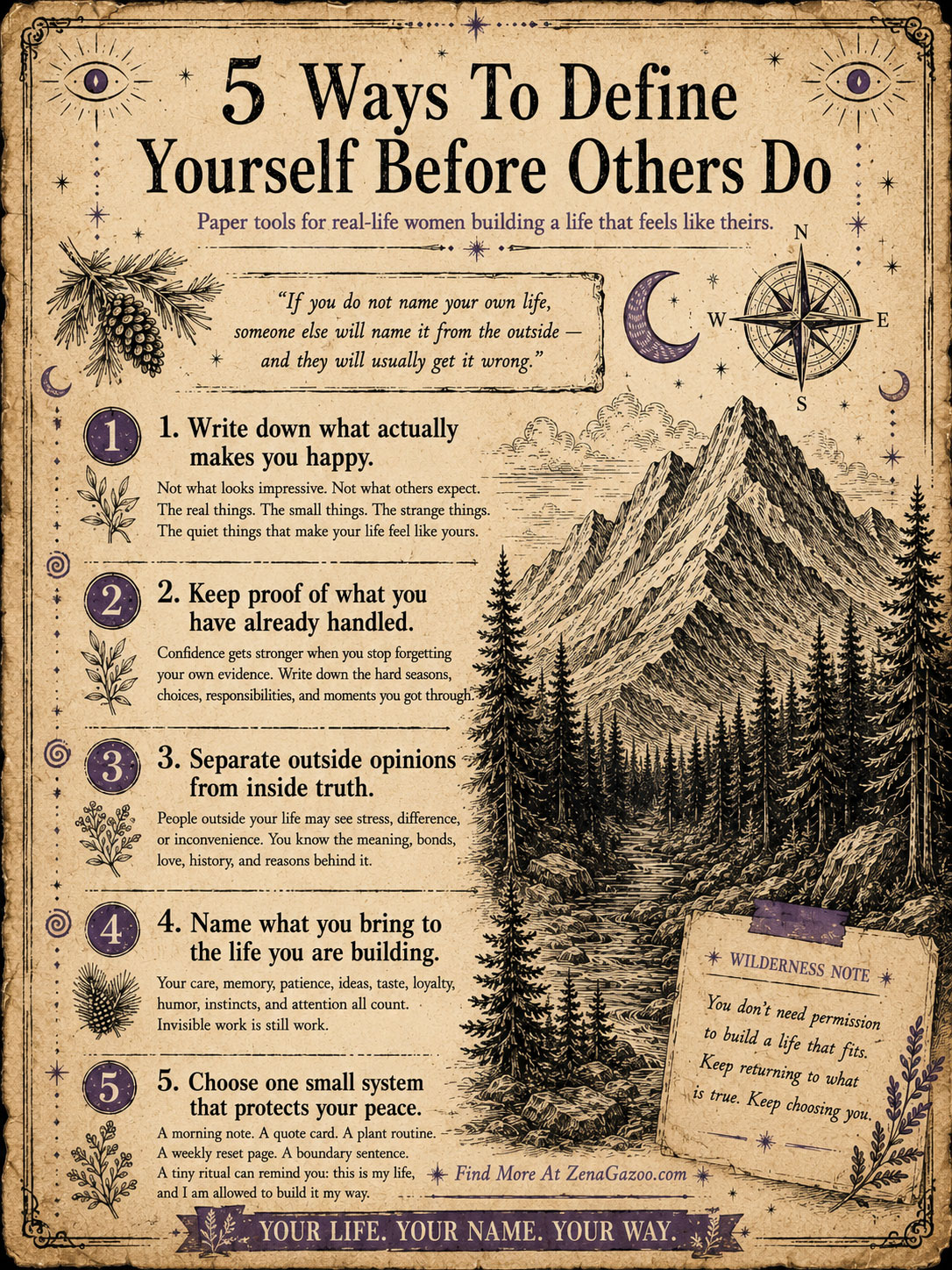
“If you do not name your own life, someone else will name it from the outside — and they will usually get it wrong.”
People are quick to define what they do not understand.
They look at the outside of your life and decide what it means. They see your choices, your relationships, your home, your work, your personality, or the way you spend your time, and they attach labels to it.
Sometimes those labels are flattering.
Sometimes they are not.
But either way, they are still coming from someone standing outside your life.
You are the one living it.
You know what the quiet moments mean. You know the history behind your choices. You know what you have survived, what you have built, what you value, and what makes you genuinely happy.
The problem is that many of us spend so much time listening to outside opinions that we stop putting words around our own lives.
That leaves an empty space.
And empty spaces get filled by other people’s assumptions.
Defining yourself does not mean becoming rigid or pretending you have everything figured out. It means learning to recognize what is true for you and giving yourself enough language to stand inside it.
Here are five ways to begin.
1. Write Down What Actually Makes You Happy
Not what looks impressive.
Not what other people expect you to want.
Not what would photograph best or earn the most approval.
What actually makes you happy?
Maybe it is growing flowers.
Maybe it is spending time with animals.
Maybe it is a quiet home, a deep relationship, a creative project, a strange little routine, a garden, music playing while you work, or coffee outside before the day gets loud.
The real things are often small.
The strange things count too.
So do the quiet things nobody else notices.
Your happiness does not become less valid because someone else would choose differently.
A useful question to ask is:
What parts of my life would I still choose even if nobody else ever saw them?
Those answers tell you a lot.
2. Keep Proof Of What You Have Already Handled
Confidence gets stronger when you stop forgetting your own evidence.
Most people remember their mistakes with amazing accuracy and their victories only vaguely.
That is backwards.
Write down the hard seasons you survived.
Write down the responsibilities you carried.
Write down the problems you figured out, the choices you made, the people you cared for, the things you built, the times you kept going when you were scared, and the moments when you trusted yourself.
Confidence does not have to begin with saying:
“I can do anything.”
Sometimes it begins with saying:
“I have already handled more than I give myself credit for.”
That is not empty motivation.
That is proof.
And proof is much harder for self-doubt to argue with.
3. Separate Outside Opinions From Inside Truth
People outside your life may see stress.
They may see inconvenience.
They may see something unconventional and assume something must be wrong.
But they do not always see the meaning underneath it.
They do not see every bond.
They do not know every conversation.
They do not know the full history behind your choices.
They do not know what has been built inside your life just because they can see part of it from the outside.
This does not mean ignoring every concern or refusing good advice. Sometimes outside perspective can be helpful.
But outside perspective is still incomplete.
A useful practice is to ask:
What do they see?
Then ask:
What do I know because I actually live here?
The space between those two answers can tell you where your own truth has been getting drowned out.
4. Name What You Bring To The Life You Are Building
People often underestimate themselves because they only count the obvious things.
Money.
Job titles.
Public achievements.
Ownership.
Visible leadership.
But a real life is built from much more than that.
Your care matters.
Your memory matters.
Your patience matters.
Your ideas matter.
Your taste matters.
Your loyalty matters.
Your humor matters.
Your instincts matter.
Your attention matters.
Maybe you are the person who notices what everyone else misses.
Maybe you remember what happened last time.
Maybe you make a place feel like home.
Maybe you keep things emotionally steady.
Maybe you ask the question that changes the direction.
Maybe you support something long enough for it to become real.
Maybe you learned by watching, listening, helping, and living.
Invisible work is still work.
And sometimes the most important parts of a life are the ones nobody thought to count.
5. Choose One Small System That Protects Your Peace
You do not need a complete reinvention.
You do not need a perfect routine.
You do not need a 47-page planner telling you how to become a more acceptable person.
Start smaller.
Choose one little system that helps you return to yourself.
A morning note.
A quote card.
A plant routine.
A weekly reset page.
A boundary sentence.
A short journal practice.
A list of things you know are true when your confidence disappears.
A folder full of proof that you have handled difficult things before.
A tiny ritual can become a reminder:
This is my life, and I am allowed to build it my way.
That may sound simple.
But repeated small choices create a life.
And repeated reminders can slowly replace the outside voices that have been defining you for years.
You Do Not Need Permission To Build A Life That Fits
You do not have to explain every part of your life until everyone else understands it.
You do not have to make your happiness look impressive.
You do not have to reject what works just because somebody else would choose differently.
You can keep returning to what is true.
You can keep choosing what fits.
You can keep learning who you are by paying attention to what your own life has already proven.
Define yourself.
Name what matters.
Keep the evidence.
Build small systems that protect what is real.
And remember:
Your life. Your name. Your way.
Find more at ZenaGazoo.com